
About
The youngest steward of a rich legacy.
Jason Henry Hunt, Kwakwaka'wakw master carver. Born in Victoria in 1973; carving at Tsax̱is (Fort Rupert), Port Hardy, BC.
The family line.
The line traces back to George Hunt, the Tlingit-English ethnologist raised Kwagu'ł at Fort Rupert, whose descendants built one of the great carving families of the Northwest Coast.
-
George Hunt, 1854 to 1933
Franz Boas's principal collaborator, leaving some 10,000 pages of writing in Kwak'wala, the Kwakwaka'wakw language. The dynasty traces to him. Wikipedia
-
Mungo Martin (Nakap'ankam), c. 1879 to 1962
Great-grandfather. A central figure of the mid-century Northwest Coast revival: head carver at Thunderbird Park, recorder of some 400 songs, tutor to Henry Hunt, Tony Hunt and Bill Reid. The Canadian Encyclopedia
-
Henry Hunt, 1923 to 1985
Grandfather. Mungo Martin's chief assistant, then head carver at Thunderbird Park from 1962 to 1974, with poles standing in Ottawa, Montreal, Buenos Aires, Berkhamsted and Osaka. Wikipedia
-
Tony Hunt Sr., 1942 to 2017
Uncle. Hereditary chief who carved roughly one hundred full-scale poles, including Kwanusila in Chicago; appointed to the Order of British Columbia in 2010. Wikipedia
-
Richard Hunt, b. 1951
Uncle. Chief carver at Thunderbird Park from 1974; the first Indigenous artist appointed to the Order of British Columbia, in 1991, and a Member of the Order of Canada, 1994. Wikidata
-
Stanley C. Hunt, b. 1954
Father. Carved six poles with Henry Hunt; his over 40-foot Plaza Canadá pole was raised in Buenos Aires in 2012, with Jason on the carving crew. Wikipedia
-
Trevor Hunt, b. 1975
Brother. Began carving in 1997 under his father Stan and his brother Jason; has carved more than 25 poles and teaches youth at Fort Rupert schools.
Jason in the line
- 1994
Begins carving under his father, watching Stan Hunt at work.
- 2010
Restores the Sunnylands Henry Hunt pole with his parents.
- 2012
Crew on his father's Plaza Canadá pole in Buenos Aires; the restored Sunnylands pole is rededicated in a public ceremony.
- 2015-16
Restores the Palm Springs city pole with his father.
- 2016
His design for the PEETZ fishing-reel maker is chosen as the City of Victoria's gift to the royal couple.
- 2019-20
Three generations of Hunt carving shown at Sunnylands Center & Gardens.
- 2024
Repaints the Jonathan Hunt House at the Royal BC Museum.
- 2025
Restores the Nootka Court poles with Richard Hunt; solo exhibition at Stonington Gallery, Seattle.
How Jason became a carver.
 Jason Henry HuntIn his words
"The main focus of my work is creating beautiful and unique custom pieces for clientele looking for quality Kwagulth art. I truly enjoy the process of talking with clients about the idea for a piece and then working some magic to bring that idea to life."
Born in Victoria in 1973, Jason is the son of Kwagulth carver and artist, Stanley Clifford Hunt. Following in the footsteps of his father and uncles, Tony Hunt and Richard Hunt, Jason has merged his trained Indigenous artistic capabilities with a unique, recognizable style that is sought after by collectors throughout North America and in Europe.
Jason studied business administration at Camosun College, then turned to carving in the summer of 1994, watching his father at work.
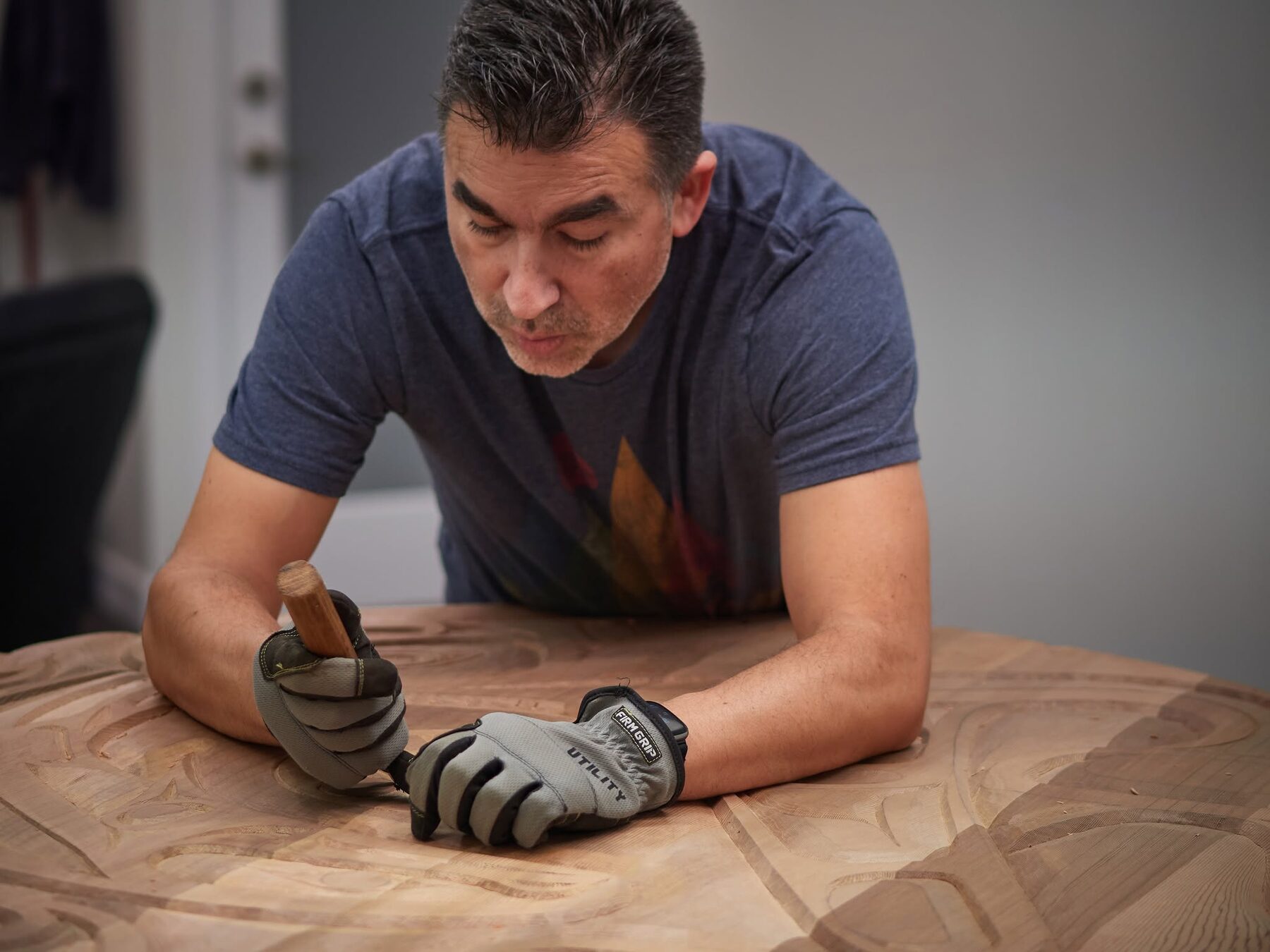
Dedicated to the values of old world craftsmanship, and favouring the use of hand tools to carve and finish his works, Jason creates signature pieces that range from totem poles and large scale panels to masks and paintings. He limits power tools to roughing out a piece, finishing his work with a knife rather than sandpaper.
"Some carvers use all power tools. We use the traditional methods."
Jason Henry Hunt, in the Reach for the Sky exhibition catalogue, Sunnylands Center & Gardens, 2019-20
Today, Jason is the youngest steward of a rich legacy of creativity that traces its roots from his father through his grandfather, Henry Hunt, to his great-grandfather, Mungo Martin (both widely credited with teaching many of today's leading artists). Jason's work explores the distinct culture and art form of the Kwagulth people while reflecting the vibrant history and knowledge of generations of acclaimed artists.
Keepers of the potlatch.
The potlatch, the great gift-giving feast at the centre of Kwakwaka'wakw law and ceremony, was illegal in Canada from 1885 to 1951. Through those years and after, the family documented, defended and rebuilt the culture in public.
-
1893
George Hunt brought a pole to the World's Columbian Exposition in Chicago in 1893. Ninety-three years later his great-grandson Tony Hunt Sr. carved its replica, Kwanusila, which stands in Chicago today.
-
1900
George Hunt was arrested under the potlatch ban and acquitted, with Franz Boas's publications entered as evidence. The family documented and defended the culture while it was against the law.
-
1953
Mungo Martin opened Wawadit'ła (Mungo Martin House at Thunderbird Park) in Victoria with the first legal public potlatch since the ban, Henry Hunt at his side.
-
2025
Jason spent the summer at Nootka Court in Victoria restoring four of his uncle Tony's poles, working with his uncle Richard: the lineage maintaining its own public legacy.
The work in the world.
Places where the family's poles and carvings stand today:
- Thunderbird Park and Wawadit'ła, Victoria, BC
- Confederation Park, Ottawa (Henry Hunt, 1971)
- Centennial Pole, Hadden Park, Vancouver, with an identical twin in Windsor Great Park, England, a 1958 gift to Queen Elizabeth II
- Kwanusila, Chicago (Tony Hunt Sr., 1986)
- Parc Jean-Drapeau, Montreal (Henry Hunt, Expo 67)
- Museum of Anthropology, UBC, Vancouver (Mungo Martin carvings)
- Canadian Museum of History, Gatineau (Stanley C. Hunt's Indian Residential School Memorial Monument)
- Sunnylands, Rancho Mirage, California (Henry Hunt, 1976; restored in 2010 by Stan Hunt with Lavina and Jason)
- Plaza Canadá, Buenos Aires (Stanley C. Hunt, 2012; Jason on the carving crew)
- Nootka Court, Victoria (Tony Hunt Sr. poles, restored by Jason in 2025)
- Mungo Martin memorial pole, Alert Bay, BC
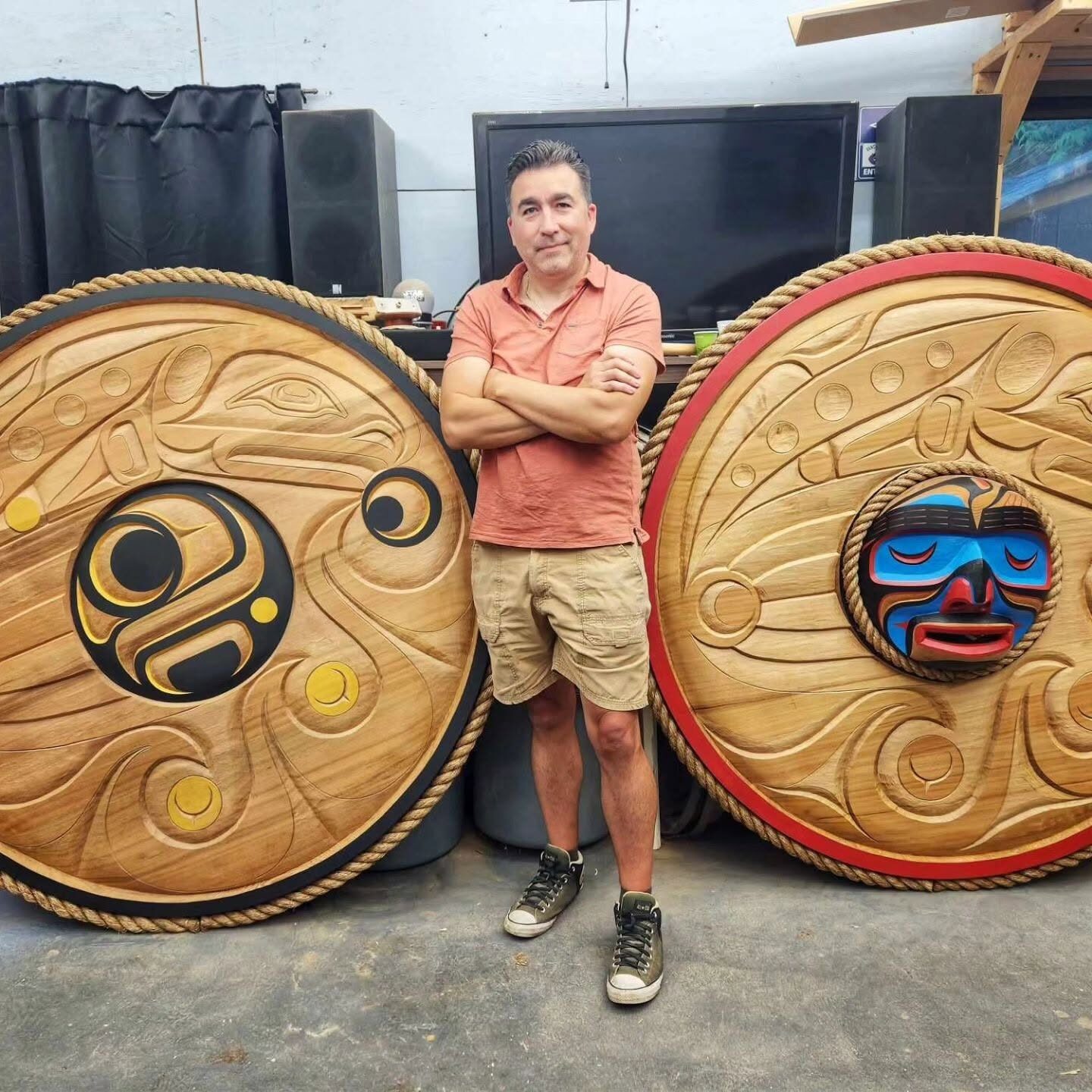
Jason carves at Tsax̱is (Fort Rupert), home of the Kwagu'ł people of the Kwakwaka'wakw, near Port Hardy on northern Vancouver Island. At Tsax̱is the carving shed is a continuous family institution: apprenticeship is tools-first, adze and curved knife, no power tools and no sandpaper.
A moon mask of his hangs in the entry hall of Eagle View Elementary School, and the Reach for the Sky catalogue records him visiting Fort Rupert schools as a role model, sharing his way of life as an artist.
You can see available panels and prints in the shop, or commission a piece designed in conversation with Jason.